
These links are provided for informational purposes only; they do not constitute an endorsement or an approval by SHINE.
Please contact us if you have a resource that could be shared on this page.

Related Websites/Networks
The World Health Organization (WHO) works with Member States to implement the tobacco control measures in the WHO Framework Convention on Tobacco Control (WHO FCTC), to reduce the prevalence of tobacco use and exposure to tobacco smoke.
The Campaign for Tobacco-Free Kids and the Tobacco-Free Action Fund are the leading advocacy organizations working to reduce tobacco use and its deadly consequences in the United States and around the world. Through strategic communications and policy advocacy campaigns, they work to change public attitudes about tobacco and promote proven policies that are most effective at reducing tobacco use and save the most lives.
Action on Smoking and Health (ASH) Wales (UK) encourages households to adopt smoke-free home rules; provides guides, educational material.
Media campaigns and policy initiatives
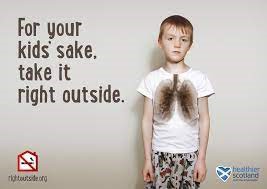
Take it Right Outside (TIRO)
The Scottish Government launched this national mass media initiative in 2014 encouraging smokers to smoke cigarettes outside their own home to protect children and other family members from second-hand smoke.
TIRO was accompanied by a world-first target aiming to reduce children’s exposure to second-hand smoke by 50% from 2012 levels by 2020. This target was achieved early in 2015 – with a reduction from 12% of children to 6% exposed to second-hand smoke. However, big inequalities still exist with much higher levels of child second-hand smoke exposure in poorer communities and no further reductions in the past 5 years.
You can access a range of TIRO videos on creating a smoke-free home, and car, and factsheets at nhsinform.scot
Resources for Parents
The Fresh Quit website includes several interactive resources for parents, relatives and carers. This includes practical information on how to protect children from second-hand smoke, facts about second-hand smoke, and information on the health risks of smoking in the car.
Training/Practitioner Resources
ASH Scotland has designed a trainer’s pack of activities and resources for early years practitioners who work directly with parent of young children. The pack is designed for use in parent sessions or parent classes rather than in a one-to-one setting.
The sessions cover the following key topics:
- Harmful chemicals in a cigarette and SHS
- What is SHS and how is it measured
- Health risks to children exposed to SHS
- Myths or misconceptions that parents/carers have about SHS
- Benefits to making a home smoke-free
- Challenges to making a home smoke-free and solutions to overcome these
- Action plan for making a home smoke-free
Please contact enquiries@ashscotland.org.uk for more information or to request a downloadable version of the full pack.
In addition, ASH Scotland has produced a pocket guide for discussing second-hand smoke with families, designed for family support workers.

Resources for Schools
NHS Greater Glasgow and Clyde developed its Jenny and the Bear story resource as part of a coordinated programme which aims to increase awareness about the effects of second hand smoke on children and what parents/carers can do to ensure their children are not exposed to its harmful effects.
The programme is aimed at Primary 1 classes and consists of a story being read to the class followed by a classroom activity to agree a name for the bear in the story, which is then entered into the competition to win a Teddy Bear mascot for their classroom. All children who take part in the programme will be given a booklet version of the story to take home.
Visit Jenny and the Bear for further details, and resources including a lesson plan and video.
Recent Publications
Semple S., Best C., Riches E., Morton L., Reid G., Howell R., O’Donnell R.C. Twenty years on from smoke-free legislation in Scotland: A secondary analysis of the Scottish Health Survey dataset ( 1998–2024 ) examining changes in household smoking rules, and salivary cotinine concentrations among non-smokers. Tobacco Induced Diseases. 2026;24(March):46. doi:10.18332/tid/219319.
Asi E, Gozum S, Karadag E. Effectiveness of interventions to reduce children’s exposure to secondhand smoke at home: a meta-analysis. J Child Fam Stud. 2026;35(4):798-811. Available from: https://doi.org/10.1007/s10826-026-03271-8
Togawa K, Fong GT, Quah ACK, et al. Impacts of revised smoke-free regulations under the 2020 Japan Health Promotion Act on cigarette smoking and heated tobacco product use in indoor public places and homes: findings from 2018 to 2021 International Tobacco Control (ITC) Japan Surveys. Tobacco Control. 2026;35:43-51. http://doi:10.1136/tc-2024-058697
Neyazi N, Chakravarty D, Xia F, Hawes MR, Max W, Kushel M, Vijayaraghavan M. Attitudes toward tobacco-free and cannabis-free policies among residents in permanent supportive housing who use tobacco, cannabis, and other substances. Addict Behav Rep. 2026;23:100686.
Howe S, Wilson T, Morphett K, Mason K, Lai G, Rees VW, Ait Ouakrim D. Estimating the harms from smoking and second-hand smoke exposure in social housing: a modelling study. Soc Sci Med. 2026;398:119197. https://doi.org/10.1016/j.socscimed.2026.119197
Sabado P, Jehi T, Chan L, Mai V. Creating smoke-free multi-unit housing as a strategy to improve health outcomes among vulnerable populations. Health Promot Pract. 2026 [epub ahead of print]. https://doi.org/10.1177/15248399261435627
Lopez-Galvez N, Mahabee-Gittens EM, Quintana PJE, Merianos AL, Dodder NG, Hoh E, Stone L, Watanabe K, Matt GE. Environmental tobacco smoke is a major contributor to lead, cadmium, and arsenic in settled house dust. Chemosphere. 2026;394:144820. https://doi.org/10.1016/j.chemosphere.2025.144820
Benazzouz RSA, Benyagoub M, Mekideche A, Benazzouz MS, Hadjersi F. Household tobacco smoke exposure in asthmatic children in Algeria: a multicenter study. Thorac Res Pract. 2026;27(2):90-95. https://doi.org/10.4274/ThoracResPract.2025.2025-8-2
Semple S, Tigova O, Howell R, et al. Protecting children from second-hand tobacco smoke in the home: the need for a new approach. Tobacco Control. 2026;35:412-414. https://doi.org/10.1136/tc-2024-059205
Villarreal YR, Northrup TF, Fischer SM, Norwood JS, Stotts AL. Negotiating health: a qualitative analysis of home smoking rules among families with medically vulnerable infants. Tob Induc Dis. 2026;24. Negotiating health: A qualitative analysis of home smoking rules among families with medically vulnerable infants
Llorens C, Dunn A, Soto P, Puvvala A, Reis V, Miron E, Kamm C, Abraham I, Sacca L. Association of exposure to smoke in households with childhood anxiety and depression in the United States: a secondary analysis from a national dataset. Psychiatry Int. 2026;7(1):32. http://doi.org/10.3390/psychiatryint7010032
Li CC, Mei S, Wu S, Hu T, Matthews AK. Barriers and facilitators to implementing indoor no-smoking policies at home among Chinese American female non-smokers. Am J Health Promot. 2026 [epub ahead of print]. http://doi.org/10.1177/08901171261434765
Berg CJ, Dekanosidze A, Owolabi S, Bundy L, Liluashvili L, Gegenava V, Grigoryan L, Torosyan A, Sargsyan Z, Hayrumyan V, Kegler MC. Adapting a brief smoke-free homes intervention for communities in Armenia and Georgia. Health Promot Int. 2025;40(3):daaf047. https://doi.org/10.1093/heapro/daaf047
Ip S, Angelo C, Cohen P, Tinker E, Andronicos A, Dickson M. Smoke-Free Home: developing an Aboriginal health promotion and social marketing campaign in Western Sydney, Australia. Health Promot J Austr. 2025;36(2):e949. https://doi.org/10.1002/hpja.949
Tigova O, Castellano Y, Fu M, Driezen P, Martínez C, Quah ACK, Fong GT, Fernández E. Determinants of smoke-free homes adoption among Spanish adults who smoke: a prospective cohort study from the 2016-2021 International Tobacco Control (ITC) EUREST-PLUS Spain Surveys. Prev Med. 2025;200:108415. https://doi.org/10.1016/j.ypmed.2025.108415
O’Donnell R, Howell R, Henderson T, et al. Use of nicotine replacement therapy to create a smoke-free home: study protocol for a pilot randomised controlled trial of a smoke-free home intervention in Scotland. BMJ Open 2025;15:e107161. https://doi.org/10.1136/bmjopen-2025-107161
Saffutra H, Yahya M, Rosemary R, Indah R, Syahrizal D. Striving for smoke-free families: wives’ role in Gayo Lues, Aceh-Indonesia. Narra J. 2025;5(2):e1960. http://doi.org/10.52225/narra.v5i2.1960
Marshall LW, Chavez-Sosa G, Gallow TG, Jovelle C, Fischbach L, Dang A, Guglielmo D, Holmes A, Kuo T. Overcoming challenges to adopting smoke-free multi-unit housing policies in a large US metropolitan area: insights and recommendations from affected groups in 20 Los Angeles county cities. Am J Health Promot. 2025;39(3):479-492. http://doi.org/10.1177/08901171241293367
Sadewa DMA, Bintoro BS. A review: how does air quality feedback benefit the implementation of the smoke-free homes initiative? J Community Empowerment Health. 2025;8(2):72-80. http://doi.org/10.22146/jcoemph.98253
Rosen L, Steinberg D, Myers V, Quah ACK, Gravely S, Fong G, et al. Should protection from tobacco smoke incursion into homes be included in FCTC strategies? Findings from the 2024 ITC Israel Survey. Tob Induc Dis. 2025;23(1):A507. Should protection from tobacco smoke incursion into homes be included in FCTC strategies? Findings from the 2024 ITC Israel Survey
Getachew B, Mbulo L. Factors associated with smoke-free rules at home among adult workers in 10 sub-Saharan African countries: Global Adult Tobacco Survey, 2012-2021. Tob Induc Dis. 2025;23(1):A302. Factors associated with smoke-free rules at home among adult workers in 10 sub-Saharan African countries: Global Adult Tobacco Survey, 2012-2021
Brys Z, Pénzes M, Békés V, et al. Gendered educational disparities and in-home smoking and use of electronic tobacco/nicotine devices among cohabiting couples: findings from a Hungarian cross-sectional survey. Tobacco Control. 2025 Oct 28 [epub ahead of print]. doi:10.1136/tc-2025-059333. http://doi.org/10.1136/tc-2025-059333
Steinberg AW, Ozga JE, Tang Z, Stanton CA, Sargent JD, Paulin LM. Rural-urban patterns in household rules limiting combustible tobacco, noncombustible tobacco, and e-cigarette use. Ann Am Thorac Soc. 2025;22(12):1836-1842. http://doi.org/10.1513/AnnalsATS.202504-419OC
Saminathan T, Lourdes T, Yusoff M. Prevalence and factors associated with secondhand smoke exposure at homes in Malaysia: findings from the Global Adult Tobacco Survey 2023. Tob Induc Dis. 2025:203-204. Prevalence and factors associated with secondhand smoke exposure at homes in Malaysia: Findings from the Global Adult Tobacco Survey 2023
Hawes MR, Chakravarty D, Cheng J, Handley MA, Tsoh JY, Lin TK, et al. The Healthy Homes Study: protocol for a cluster randomized trial of a place-based smoke-free home intervention in affordable housing. PLoS One. 2025;20(7):e0328786. http://doi.org/10.1371/journal.pone.0328786
O’Donnell R, Bintoro BS, Rustandi AW, Farahdilla ZA, Sadewa DMA, Padmawati RS, et al. COmmunities Facilitating incREasing Smoke-free Homes (CO-FRESH): co-developing a toolkit with local stakeholders in Indonesia and Malaysia. BMJ Global Health. 2025;10:e018102. https://doi.org/10.1136/bmjgh-2024-018102
Garritsen, Heike H., et al. “Associations of smoke‐free policies in multi‐unit housing with smoking behavior and second‐hand smoke exposure: A systematic review.” Addiction 120.4 (2025): 578-588. https://doi.org/10.1111/add.16724
Vijayaraghavan M, Hartman-Filson M, et al. Multi-level influences of smoke-free policies in subsidized housing: applying the COM-B model and neighborhood assessments to inform smoke-free policies.” Health Promotion Practice 26.1 (2025): 142-157. https://doi.org/10.1177/15248399231174925
Chen T, Wang P, et al. “Increasing trends of household secondhand smoke exposure and widening socioeconomic disparities in Hong Kong adolescents, 2010–2020.” American Journal of Preventive Medicine 68;4 (2025): 735-744. https://doi.org/10.1016/j.amepre.2024.12.019